Marriott Hotels: 15 Remarkable Facts Behind Their Global Success
Table of Contents
Marriott hotels stand as a colossal entity in the global hospitality landscape, synonymous with diverse accommodation options, unparalleled service, and a rich history stretching back nearly a century. From its humble beginnings as a root beer stand in Washington, D.C., Marriott International has burgeoned into the world’s largest hotel company by room count, operating, franchising, and licensing a vast array of lodging brands across the globe. This comprehensive article delves into the various facets that define Marriott’s enduring success and influence within the travel industry, exploring its storied past, extensive brand portfolio, global footprint, commitment to innovation, loyalty programs, and dedication to corporate responsibility.
A Legacy of Hospitality: The Marriott Story
The Marriott Corporation traces its origins to 1927, when John Willard Marriott and his wife Alice, along with a business partner, opened an A&W Root Beer stand in Washington, D.C.. The humid D.C. summers inspired J. Willard Marriott to offer cool beverages, a venture that quickly expanded to include food, evolving into “The Hot Shoppes” restaurant chain. This modest enterprise laid the groundwork for a hospitality empire, built on core values that continue to guide the company today.
The company officially entered the hotel business on January 16, 1957, with the opening of the Twin Bridges Motor Hotel in Arlington, Virginia. This 370-room property, adjacent to a Hot Shoppe, marked a pivotal moment, establishing Marriott’s presence in the lodging sector. In 1964, J.W. “Bill” Marriott, Jr. became president, and in 1967, Hot Shoppes, Inc. was renamed the Marriott Corporation, reflecting its broadened focus. Bill Marriott, who assumed the CEO role in 1972, spearheaded the company’s expansion into a formidable hotel chain, particularly targeting business travelers with the introduction of brands like Courtyard in 1983, Residence Inn in 1987, and Fairfield Inn in the same year.
A significant corporate restructuring occurred in 1993 when Marriott Corporation split into two distinct companies: Marriott International, Inc., which manages and franchises properties, and Host Marriott Corporation (now Host Hotels & Resorts), which primarily owns properties. This strategic move allowed Marriott International to focus on its asset-light business model of managing and franchising. The company further expanded its luxury portfolio by acquiring a 49% interest in The Ritz-Carlton Hotel Company in 1995, eventually gaining near-full ownership by 1998. Another landmark acquisition came in September 2016, when Marriott closed its merger with Starwood Hotels & Resorts Worldwide, creating the world’s largest hotel company with a portfolio of 30 brands and over 5,700 properties. This merger significantly bolstered Marriott’s international presence, as approximately 75% of Starwood’s revenues originated from non-U.S. markets.
The Expansive Marriott Portfolio: A Brand for Every Traveler
Marriott International boasts an unparalleled portfolio of brands, categorized to cater to virtually every traveler and price point, from ultra-luxury to extended-stay and select-service options. As of 2025 financial documents, the company operates 41 brands with 9,361 properties containing 1,706,331 rooms in 144 countries and territories. Other sources indicate approximately 36 to 40 brands with over 9,000 properties. This diverse ecosystem ensures that Marriott can meet varied guest needs and preferences. The brands are generally grouped into categories such as Luxury, Premium, Select, Longer Stays, and Collections.
Luxury Brands represent the pinnacle of Marriott’s offerings, providing exceptional service, exclusive experiences, and high-end design. This category includes iconic names such as The Ritz-Carlton, renowned for its personalized service and thoughtful amenities; St. Regis Hotels & Resorts, famous for its signature rituals and bespoke service; JW Marriott, focusing on guest well-being; EDITION, known for its sophisticated design; The Luxury Collection, a group of unique, indigenous hotels; and W Hotels, offering vibrant and design-led experiences.
Premium Brands balance quality and comfort at a more accessible price point with broader global distribution. This segment features the flagship Marriott Hotels brand, Delta Hotels, Le Méridien, Renaissance Hotels, Sheraton, and Westin Hotels & Resorts. These brands often provide comprehensive amenities including meeting spaces, diverse dining options, and well-equipped fitness centers.
The Select Service category focuses on essential amenities and efficient service for travelers seeking comfort and convenience without unnecessary frills. Brands in this category include Courtyard by Marriott, Fairfield by Marriott, Four Points by Sheraton, AC Hotels, Aloft Hotels, and Moxy Hotels. Marriott also recently launched new midscale brands like StudioRes in the U.S. and Canada and acquired City Express in the Caribbean and Latin America, alongside Four Points Express by Sheraton for EMEA, to further cater to this growing segment.
For guests requiring longer stays, Marriott offers specialized brands under the Longer Stays category, which provide spacious rooms, kitchen facilities, and home-style amenities. These include Residence Inn by Marriott, TownePlace Suites by Marriott, Element Hotels by Westin, and Marriott Executive Apartments. Additionally, the Collections Brands, such as Autograph Collection Hotels, Tribute Portfolio, and Design Hotels, encompass independently owned and operated hotels that maintain their unique identities while benefiting from Marriott’s extensive network. These properties offer distinctive, boutique-style experiences. Marriott’s portfolio also includes Homes & Villas by Marriott Bonvoy for premium home rentals and Marriott Vacation Club for timeshare properties.
Global Reach and Economic Impact
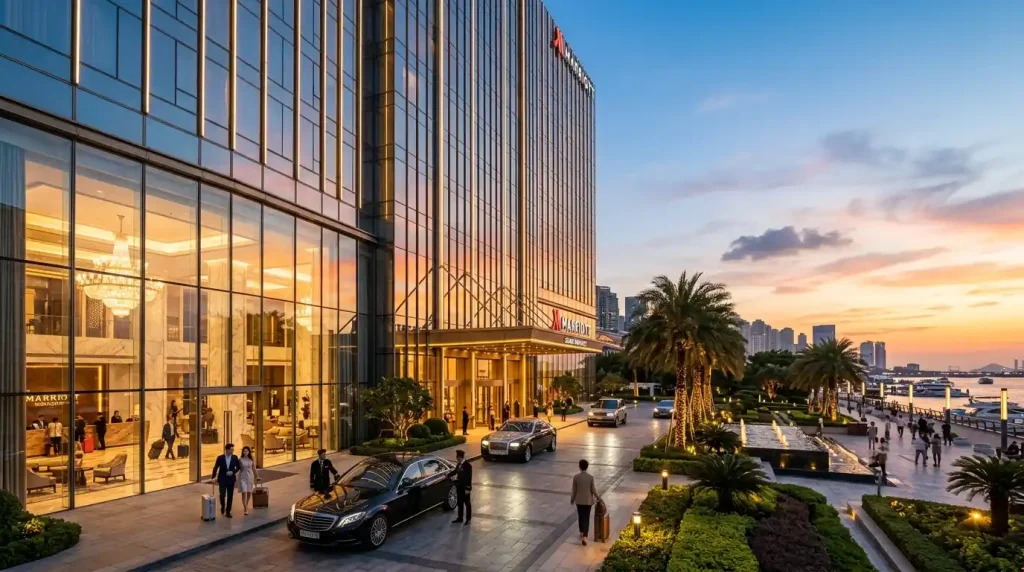
Marriott International’s global footprint is truly expansive, positioning it as the largest hotel company worldwide by room count. As of year-end 2025, Marriott’s system encompassed 9,805 properties and 1,779,936 rooms across 145 countries and territories. The company’s vast network extends across all continents, with a significant presence in major urban centers, airports, and top leisure destinations. Its operations are typically segmented into U.S. & Canada, Europe, Middle East & Africa (EMEA), Greater China, and Asia Pacific excluding China (APEC).
The company continues to demonstrate robust growth, with a development pipeline of approximately 4,100 properties and nearly 618,000 rooms as of early 2026, with 43 percent of these rooms under construction. In the first quarter of 2026 alone, Marriott added roughly 15,900 net rooms globally, representing a 4.5 percent growth from the end of the first quarter of 2025. This growth is not merely in numbers but also strategic, focusing on expansion in key markets. For instance, in 2025, Marriott significantly expanded its presence in the Caribbean and Latin America (CALA) region, adding 39 properties and 4,292 rooms, bringing its regional footprint to 555 open properties across 37 countries and territories. The company is also making strategic moves in Europe, with plans to add nine new hotels in Greece, including the debut of the Residence Inn by Marriott and Le Méridien brands in the country.
Marriott’s extensive global operations naturally translate into substantial economic impact. The company reported a total revenue of $6.65 billion for Q1 2026, marking a 6% increase compared to the same quarter last year, driven by a 4.2% increase in Revenue Per Available Room (RevPAR) worldwide. Adjusted earnings per share (EPS) for Q1 2026 came in at $2.72, surpassing analyst forecasts. This robust financial performance underscores Marriott’s operational efficiency and effective market strategies. The company’s asset-light business model, primarily based on franchising, management, and licensing agreements, generates substantial cash flow, allowing for significant capital returns to shareholders.
Marriott also contributes significantly to local economies through job creation, tourism promotion, and partnerships with local suppliers. The company had 418,000 employees in 2024. Its presence in 144 countries and territories supports a vast ecosystem of related businesses and services. The growth in international markets, particularly in Europe and the Middle East, continues to drive strong inbound travel, benefiting local economies.
| Key Marriott International Statistics (as of 2025/Q1 2026) | Value |
|---|---|
| Number of Brands | 41 (others state 36-40) |
| Number of Properties | 9,361 (2025 financial documents), 9,805 (year-end 2025), 9,000+ (2023) |
| Total Rooms | 1,706,331 (2025 financial documents), ~1.78 million (year-end 2025) |
| Countries and Territories | 144, 145 (year-end 2025) |
| Development Pipeline (Rooms) | Nearly 618,000 rooms (early 2026) |
| Q1 2026 Worldwide RevPAR Growth | 4.2% |
| Q1 2026 Adjusted Net Income | $726 million |
| Q1 2026 Adjusted EBITDA | $1,398 million |
Elevating the Guest Experience: Innovation and Services
Marriott International consistently strives to enhance the guest experience through continuous innovation and a wide array of services. The company has been a pioneer in hotel technology advancements, being the first hotel company to offer online reservations in 1995. Today, Marriott places significant emphasis on integrating technology to improve guest stays and operational efficiency.
A major focus of Marriott’s innovation strategy involves a substantial investment in digital and technological advancements. In 2025, Marriott committed over $1.1 billion towards these efforts, with more than one-third directed toward digital and technology transformation in 2026. This investment includes replatforming core systems like its property management system, central reservations infrastructure, and loyalty platform, moving them to cloud-native environments for unified guest data, API-first integrations, and real-time analytics. The goal is to create a “shared intelligence layer” to support AI agents across various functions, potentially redefining customer acquisition and personalization.
Beyond behind-the-scenes technology, Marriott integrates innovation directly into the guest experience. This includes mobile check-in and keyless entry, allowing guests to use their smartphones to access rooms and bypass the front desk. Hotels offer complimentary in-room Wi-Fi, enhancing connectivity for all members. Marriott also focuses on holistic wellness, incorporating technology-driven treatments like massage robots, virtual reality meditation, and red-light therapy in its luxury properties.
Marriott hotels offer a range of services and amenities designed to meet modern travelers’ diverse needs. These often include state-of-the-art fitness centers, dynamic “Greatroom” lobbies designed for connection and relaxation, and sophisticated guest rooms with premium comfort and integrated technology. Many properties also feature exclusive M Clubs, providing complimentary snacks, premium Wi-Fi, and a private escape for eligible guests. Dining options at Marriott properties often combine classic flavors with local inspiration, reflecting the culture of each destination. For information on specific hotel amenities, guests can easily check the Marriott website or the Marriott Bonvoy Mobile App. The company’s commitment to thoughtful design and attentive service ensures a consistent, high-quality experience across its vast portfolio.
The Power of Loyalty: Marriott Bonvoy
At the heart of Marriott’s customer retention strategy is Marriott Bonvoy, its comprehensive and highly acclaimed travel loyalty program. Launched in 2019, Marriott Bonvoy unified the three predecessor programs: Marriott Rewards, Starwood Preferred Guest (SPG), and The Ritz-Carlton Rewards, bringing all of Marriott’s hotel brands under a single points currency and elite status structure. This consolidation created one of the world’s largest hotel loyalty programs, boasting over 150 million members globally.
Marriott Bonvoy is free to join and offers immediate benefits to members, including complimentary in-room Wi-Fi, exclusive member rates, and mobile check-in services. Members earn points on qualifying hotel stays, typically 10 points per dollar spent at most properties, and these points can be redeemed for free nights, airline miles, unique experiences, and gift cards. A significant perk is the “fifth night free” on award stays, providing added value for longer trips.
The program features a tiered elite status system with six membership levels, each offering progressively better perks based on the number of qualifying nights stayed per calendar year.
- Member: (0 nights) Basic benefits including free Wi-Fi, member rates, mobile check-in/key.
- Silver Elite: (10 nights) All Member benefits plus 10% bonus points on stays and the ability to request late checkout (based on availability).
- Gold Elite: (25 nights) All Silver Elite benefits plus 25% bonus points, 2 p.m. late checkout (based on availability), space-available room upgrades (excluding suites), and a welcome gift of points at check-in.
- Platinum Elite: (50 nights) All Gold Elite benefits plus 50% bonus points, guaranteed 4 p.m. late checkout, enhanced room upgrades (including select suites, based on availability), and guaranteed lounge access at eligible hotel brands (like JW Marriott, Marriott Hotels, Sheraton, and Renaissance).
- Titanium Elite: (75 nights) All Platinum Elite benefits plus 75% bonus points, a higher annual choice benefit, and enhanced dedicated elite support.
- Ambassador Elite: (100 nights + $23,000 in qualifying spend) All Titanium Elite benefits plus a personal Ambassador service and “Your24” flexible check-in/checkout.
Marriott Bonvoy also offers co-branded credit cards that allow members to earn points on everyday spending and often come with automatic elite status or elite night credits, accelerating their path to higher tiers. The program’s evolution continues with enhancements aimed at offering guests exclusive rewards, personalized offers, and seamless access to reservations, further strengthening Marriott’s relationship with its loyal customer base.
Corporate Responsibility and Sustainability: Serve 360
Marriott International is deeply committed to corporate social responsibility (CSR) and sustainability, guided by its “Serve 360: Doing Good in Every Direction” platform. This comprehensive strategy is grounded in the company’s core values and aims to make a positive and sustainable impact wherever Marriott does business. Serve 360 focuses on four key areas: Nurture Our World, Sustain Responsible Operations, Empower Through Opportunity, and Welcome All & Advance Human Rights.
Under the “Nurture Our World” pillar, Marriott emphasizes environmental stewardship and community engagement. The company has set ambitious 2025 sustainability and social impact goals, including reducing carbon intensity by 30%, water intensity by 15%, and waste to landfill by 45% (with a 50% cut in food waste). Marriott is also striving to achieve 30% renewable electricity across its portfolio and has committed to reaching net-zero greenhouse gas emissions by no later than 2050 across its value chain. These targets have received validation from the Science Based Targets initiative (SBTi), aligning Marriott’s goals with the latest climate science.
To “Sustain Responsible Operations,” Marriott implements various eco-friendly initiatives across its properties. This includes using energy-efficient technologies like smart thermostats, LED lighting, and efficient heating and cooling systems. The company also focuses on water conservation through low-flow fixtures and smart irrigation systems, and waste reduction efforts such as eliminating single-use plastics (e.g., plastic straws and small toiletry bottles) and piloting food waste tracking software and composting programs. New hotels are designed with sustainability in mind, utilizing eco-friendly materials and pursuing green building certifications like LEED. Marriott also emphasizes responsible sourcing, aiming to locally source 50% of produce by 2025 and responsibly source 95% of its top 10 priority categories. The company collaborates with industry partners like Ecolab to implement innovative technologies that reduce environmental impact without compromising guest experience.
Marriott’s commitment extends to “Empowering Through Opportunity” by prioritizing associate well-being, creating career pathways, and fostering an inclusive and supportive work environment. The company also aims to “Welcome All & Advance Human Rights,” striving to combat human trafficking within the industry and make travel more accessible. Marriott actively engages with local communities, providing career training for youth, supporting children’s hospitals and SOS villages, and investing in natural capital initiatives like rainforest protection and coral restoration. The company had set a goal to contribute 15 million hours of volunteer service by 2025, with half of those hours dedicated to youth development. These efforts underscore Marriott’s dedication to being a responsible corporate citizen and a force for good in the world, as highlighted by its 2024 Serve 360 Report which outlines progress on Environmental, Social, and Governance (ESG) initiatives Marriott International Corporate Social Responsibility.
The Future of Hospitality: Marriott’s Vision
As Marriott International approaches its centennial, the company continues to look forward, adapting to evolving traveler expectations and leveraging new technologies to maintain its leadership position in the hospitality sector. Marriott’s vision for the future is characterized by strategic growth, continued technological advancement, and a sustained commitment to its core values.
Strategic growth remains a priority, with plans to add between 230,000 and 270,000 net rooms between year-end 2022 and 2025, expanding its global portfolio to nearly 1.8 million rooms. The company is particularly focused on rooms growth in the midscale and luxury segments, recognizing increased traveler spending in luxury and the demand for value-oriented options. Hotel conversions and adaptive reuse projects are also critical pieces of Marriott’s growth strategy, allowing for expansion by transforming existing buildings into new hotels. Marriott’s robust development pipeline, reaching a new record of over 4,100 properties and nearly 618,000 rooms in early 2026, signals strong confidence in future expansion. This includes significant planned expansion in regions like the Caribbean and Latin America, with new City Express by Marriott properties in countries like Argentina and El Salvador, and luxury developments such as Ritz-Carlton Reserve resorts. New Marriott Vacation Club resorts are also planned in locations like Bali and Nashville through 2027.
Technological advancement is at the forefront of Marriott’s future strategy. The company is undergoing an ambitious technology overhaul, committing substantial investment to replatform its core systems and build a cloud-native travel innovation platform. This modernization effort, centered on unified guest data and AI-first integrations, aims to enhance personalization, streamline customer experiences, and improve operational efficiencies. Marriott views AI as a long-term opportunity to redefine customer acquisition and service paradigms, although it acknowledges the early stages of its practical application. Digital retail capabilities, including easier search, room attribute pricing, and flexible payment options, are also being introduced to optimize the customer journey.
Furthermore, Marriott’s commitment to sustainability and social impact through its Serve 360 platform will continue to shape its future. The company’s ongoing efforts to reduce environmental impacts, source responsibly, and empower communities are integral to its long-term business strategy and reputation. By integrating sustainability into hotel design, operations, and supply chains, Marriott aims to meet its ambitious 2025 goals and progress towards net-zero emissions by 2050. The company recognizes that a resilient and ethical business is crucial for sustained success.
Conclusion
Marriott International has evolved from a single root beer stand into a global hospitality leader, defining luxury, comfort, and innovation for travelers worldwide. Its extensive portfolio of brands caters to a broad spectrum of guests, while its vast global presence underpins its significant economic influence. Through continuous technological advancements, particularly in digital transformation and AI, Marriott is enhancing guest experiences and streamlining operations. Simultaneously, its steadfast commitment to corporate social responsibility and sustainability, guided by the Serve 360 platform, ensures a positive impact on communities and the environment. As Marriott looks towards its next century, its strategic expansion, pioneering spirit in technology, and deeply ingrained values promise to further solidify its position as a true powerhouse in the global hospitality industry, continuing to shape the future of travel.